

A Town, A Team, and a Dream
By H.G. Bissinger
He saw the irresistible allure of high school sports, but he also saw an inevitable danger in adults’ living vicariously through their young. And he knew of no candle that burned out more quickly than that of the high school athlete.
“Athletics lasts for such a short period of time. It ends for people. But while it lasts, it creates this make-believe world where normal rules don’t apply. We build this false atmosphere. When it’s over and the harsh reality sets in, that’s the real joke we play on people. …Everybody wants to experience that superlative moment, and being an athlete can give you that. It’s Camelot for them. But there’s even life after it.”
With the kind of glory and adulation these kids received for a season of their lives, I am not sure if they were ever encouraged to understand that. As I stood in the beautiful stadium on the plains week after week, it became obvious that these kids held the town on their shoulders.
(Bissinger 2015, xiv)
He had no other expectations beyond the physical thrill of it. He didn’t have to rely on it or draw all his identity from it. “I played because I like it,” he once said. “Others played because it was Permian football. It was their ticket to popularity. It was just a game to me, a high school game.”
(Bissinger 2015, 13)
“MO-JO! MO-JO! MO-JO! MO-JO!”
Chants of the Permian moniker, which was taken from the title of an old Wilson Pickett song and stuck to the team after a bunch of drunken alumni had yelled the word for no apparent reason during a game in the late sixties, passed through the home side.
(Bissinger 2015, 15)
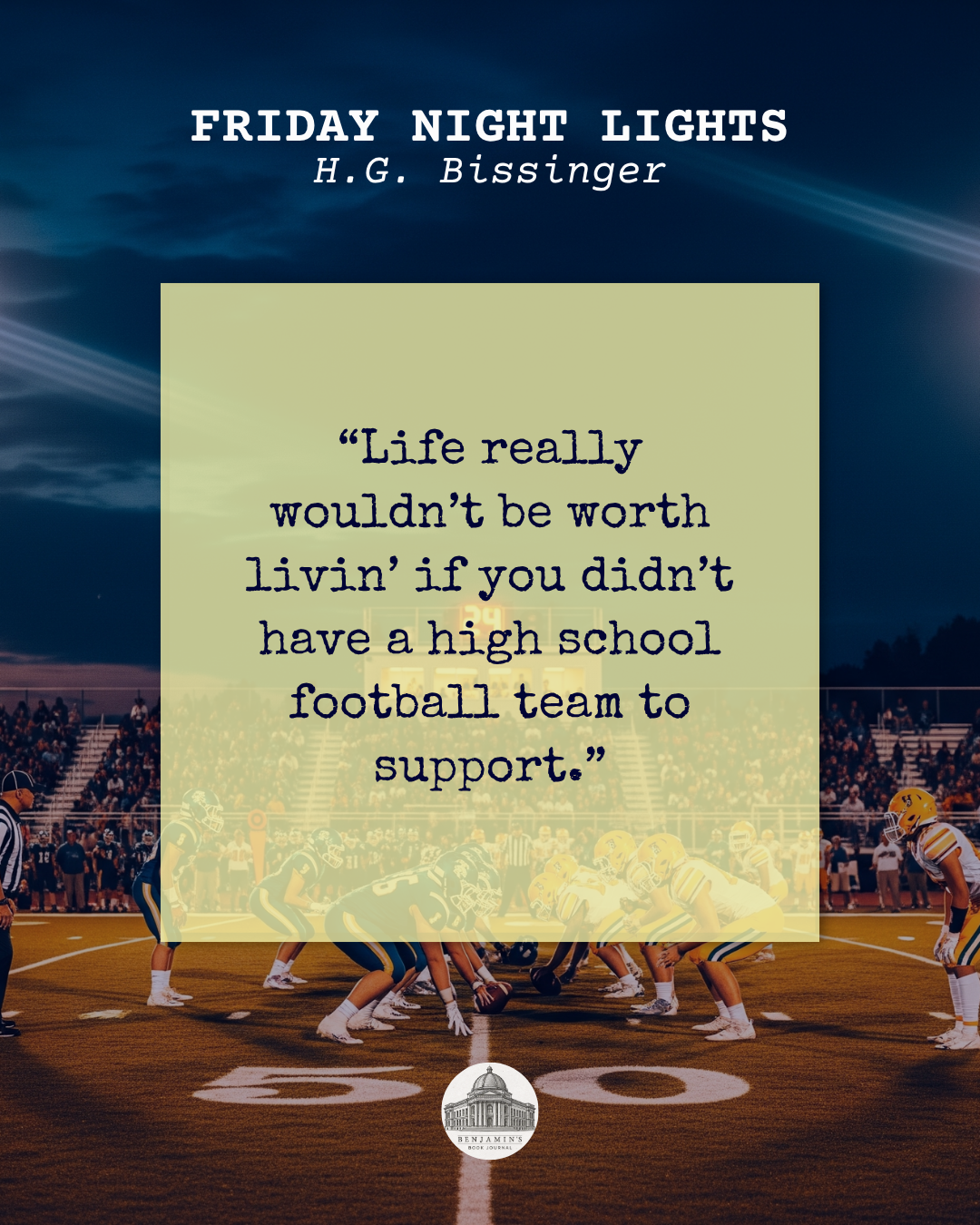
After all, he was a high school football coach, and after all, this was Odessa, where Bob Rutherford, an affable realtor in town, might as well have been speaking for thousands when he casually said one day as if talking about the need for a rainstorm to settle the dust, “Life really wouldn’t be worth livin’ if you didn’t have a high school football team to support.”
(Bissinger 2015, 20)
It was still a place that seemed on the edge of the frontier, a paradoxical mixture of the Old South and the Wild West, friendly to a fault but fiercely independent, God-fearing and propped up by the Baptist beliefs in family an flag but hell-raising, spiced with the edge of violence but naive and thoroughly unpretentious.
(Bissinger 2015, 32)
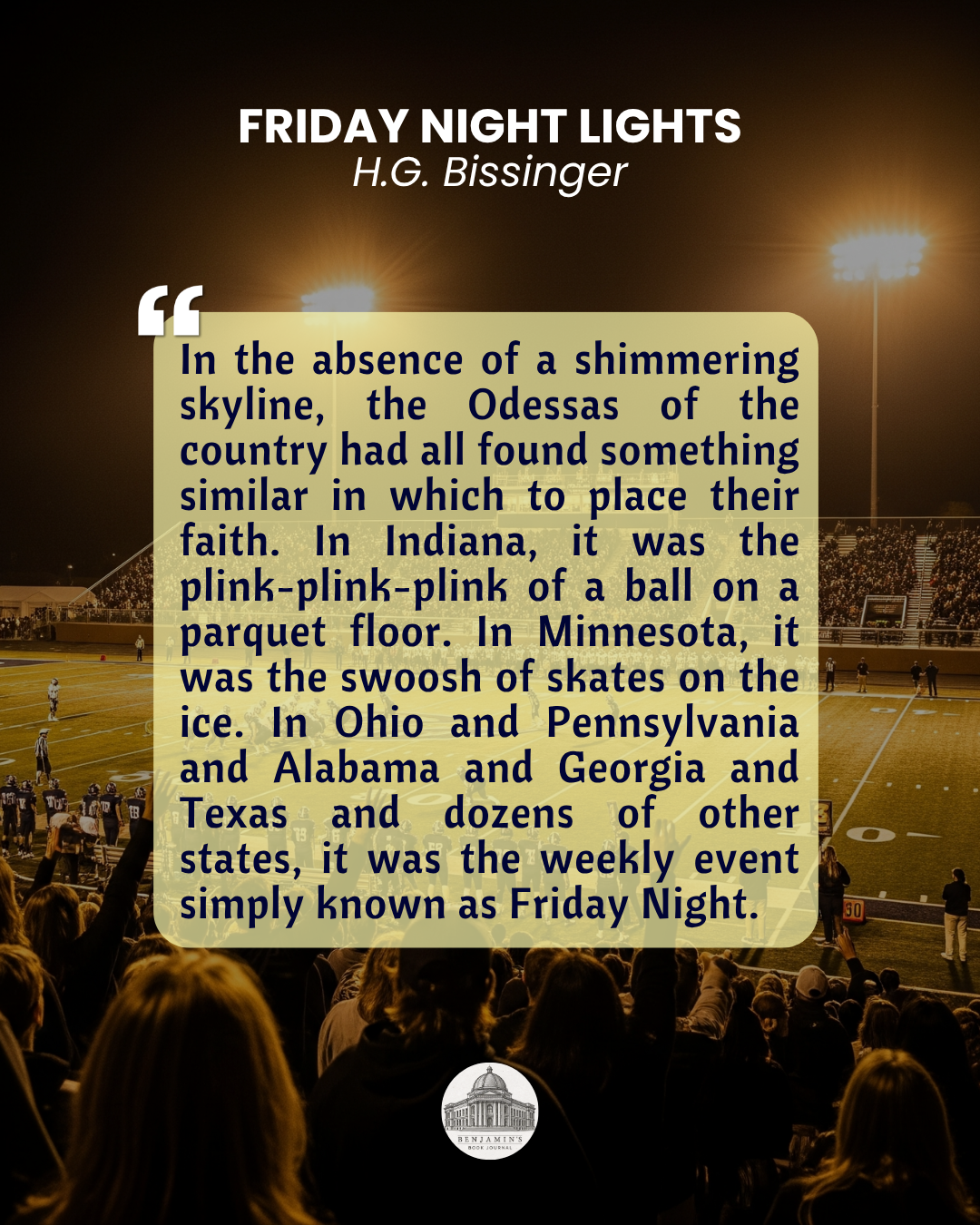
In the absence of a shimmering skyline, the Odessas of the country had all found something similar in which to place their faith. In Indiana, it was the plink-plink-plink of a ball on a parquet floor. In Minnesota, it was the swoosh of skates on the ice. In Ohio and Pennsylvania and Alabama and Georgia and Texas and dozens of other states, it was the weekly event simply known as Friday Night.
(Bissinger 2015, 35)
The fans clutched in their hands the 1988 Permian football yearbook, published annually by the booster club to help generate funds for the program. It ran 224 pages, had 513 individual advertisements, and raised $20,000. Virtually every lawyer, doctor, insurance firm, car dealer, restaurant, and oil field supply business in town had taken out an ad, both as a show of support for Permian football and, perhaps, as a form of protection. The Ector County sheriff had taken out an ad. So had the Ector County Democratic party, just in case there were a few closet Democrats who, under conditions similar to those offered a Mafia informant in the witness protection program, might be willing to divulge their political persuasion.
(Bissinger 2015, 42)
The dominance of football in Texas high schools had become the focus of raging debate all over the state in 1983. The governor of Texas, Mark White, appointed Perot to head a committee on educational reform. In pointing to school systems he thought were skewed in favor of extracurricular activities, Perot took particular aim at Odessa.
On ABC’s Nightline, he called Permian fans “football crazy,” and during the show it was pointed out that a $3.6 million high school football stadium had been built in Odessa in 1982. The stadium included a sunken artificial-surface field eighteen feet below ground level, a two-story press box with VIP seating for school board members and other dignitaries, poured concrete seating for 19,032, and a full-time caretaker who lived in a house on the premises.
“He made it look like we were a bunch of West Texas hicks, fanatics,” said Allen of Perot. The stadium “was something the community took a lot of pride in and he went on television and said you’re a bunch of idiots for building it.” Most of the money for the stadium had come from a voter-approved bond issue.
The war against Perot escalated quickly. The booster club geared up a letter-writing campaign to him, state legislators, and the governor. Nearly a thousand letters were sent in protest of Perot’s condemnation of Odessa. Some of the ones to him were addressed “Dear Idiot” or something worse than that, and they not so gently told him to mind his own damn business and not disturb a way of life that had worked and thrived for years and brought the town a joy it could never have experienced anywhere else.
“It’s our money,” said Allen of the funds that were used to build the stadium. “If we choose to put it into a football program, and the graduates from our high schools are at or above the state level of standards, then screw you, leave us alnot.” At one point Perot, believing his motives had been misinterpreted and hoping to convince people that improving education in Texas was not a mortal sin, contemplated coming to Odessa to speak. But he decided against it, to the relief of some who thought he might be physically harmed if he did.
(Bissinger 2015, 44-45)
Bush then left to give a speech at the Petroleum Museum to an audience of independent oilmen. He talked about his time in Midland and his wife Barbara’s “world record as the mother that watched the most Little League games.” He talked about a community pulling together in the fifties when times were not simply tough but “pretty darn tough.” Mostly he talked about “values,” the most important buzzword to be added to the lexicon of American politics in the 1988 election.
“My values have not changed a bit since I was your neighbor in the fifties. My values are values like everyone here that I think of: faith, family, and freedom, love of country and hope for the future. Texas values. Some just call it just plain common sense. …”
(Bissinger 2015, 203)
And yet when it came to the election none of the devastation seemed to matter. “The Republicans have done nothing to help the Texas oilman for the last eight years,” said Clayton Williams, a Midland oilman. “But when it comes down to voting for a liberal versus a conservative, most oilmen are conservative.
“If other oilmen are like me, they’re probably going to bitch and scream and moan. And then go ahead and vote out principles – conservative.”
Voting on principles was hardly a new phenomenon, but it seemed to go a step further in 1988. In Odessa and Midland, as in other places, liberalism had come to be perceived not as a political belief but as something unpatriotic and anti-American, something that threatened the very soul of the hardworking whites who had built this country and made it great. And Dukakis, by the very way he looked and acted, embodied every bad stereotype of a liberal – brooding, clinched, frowning, swarthy, hairy, a man who came across as one gigantic, furrowed eyebrow.
(Bissinger 2015, 204-205)
“I don’t think they realize these are sixteen, seventeen, eighteen-year-old kids,” she once said. “I don’t think they realize these are coaches. They are men, they are not gods. They don’t realize it’s a game and they look at them like they’re professional football players. They are kids, highschool kids, the sons of somebody, and they expect them to be perfect.”
Yes, they did, and they had too much invested in it emotionally to ever change. Permian football has become too much a part of the town and too much a part of their own lives, as intrinsic and sacred a value as religion, as politics, as making money, as raising children. That was the nature of sports in a town like this. Football stood at the very core of what the town was about, not on the outskirts, not on the periphery. It had nothing to do with entertainment and everything to do with how people felt about themselves.
“They don’t have any idea about the coaches and the time they put in and dedication,” she said. “They don’t have any idea, and they don’t care. They don’t have any idea of what the families give up.”
(Bissinger 2015, 255)
If he was looking for any reprieve from the fans in the succeeding days, he wasn’t going to get it. A few, like Bobby Boyles, rose to his defense. Boyles was a die-hard booster, one of those who set his life each fall to the clock of the season. He and his wife sat there at the booster club meeting every Tuesday night and at the junior varsity game every Thursday night and at the varsity game every Friday night, wearing their black as proudly as a priest wears his collar. He needed Permian football as much as anyone, but he couldn’t stand the attacks on Gaines. He was sitting at the Kettle restaurant over on Andrews when someone came round to the table the Monday after the game to ask him to sign a petition to get Gaines fired, and he bluntly told the person, “Go to hell.”
“Lose two games by two points and they’re ready to hang ‘im,” he said quietly at the booster club meeting that Tuesday night following the loss to the Rebels. “What it is, they’re spoiled. They’ve won too damn many. They need about five years of losing and then they’d think Gary was great.”
(Bissinger 2015, 257)
The Permian Panthers finished the regular season on the first Friday night of November by pummeling the San Angelo Bobcats. That same night, the Midland Lee Rebels finished the season by routing the Cooper Cougars, and the Midland High Bulldogs did likewise by beating the Abilene High Eagles. All three teams had identical five and one records in the district, and a numbing scenario was set up.
Since only two teams could go to the playoffs, the district’s tiebreaker rule went into effect: a coin toss.
After all that work and all those endless hours, it seemed silly. But that’s what the outcome of the season had finally been reduced to – three grown men still dressed in their coach’s outfits driving in the middle of the night to a truck stop so they could stand together like embarrassed schoolboys and throw coins into the air to determine whether their seasons ended at that very moment or continued.
It was a simple process of odd man out. If there were two tails and a heads, the one who flipped heads did not make the playoffs. If there were two heads and a tails, the one who flipped tails did not make the playoffs. If they all flipped the same, they just did it again until someone last.
(Bissinger 2015, 271)
“There’s four teams left in the state of Texas, and the Permian Panthers are one of those four,” Gaines softly told his players moments before it was time to take to the field. They huddled around him on one knee, their faces so earnest, so filled with nervousness and hope, and they truly did seem like a family, the bunch of brothers that Gaines had talked about so long ago before the Odessa High game. It seemed corny then, the kind of sentiment coaches always tried to invoke. But it didn’t now. They were together, white and black and Hispanic, rich and poor, and they would stay that way for as long as they were a team, as long as they had another game to play.
“We got to go out with the attitude that we are not going to get beat,” said Gaines. “We are not going to accept anything less than a win. That’s the attitude that we have to have. They’ve played some good football teams but I don’t think they’ve played anybody capable of getting after ‘em for forty-eight minutes like we’re capable of getting after ‘em.”
(Bissinger 2015, 344)
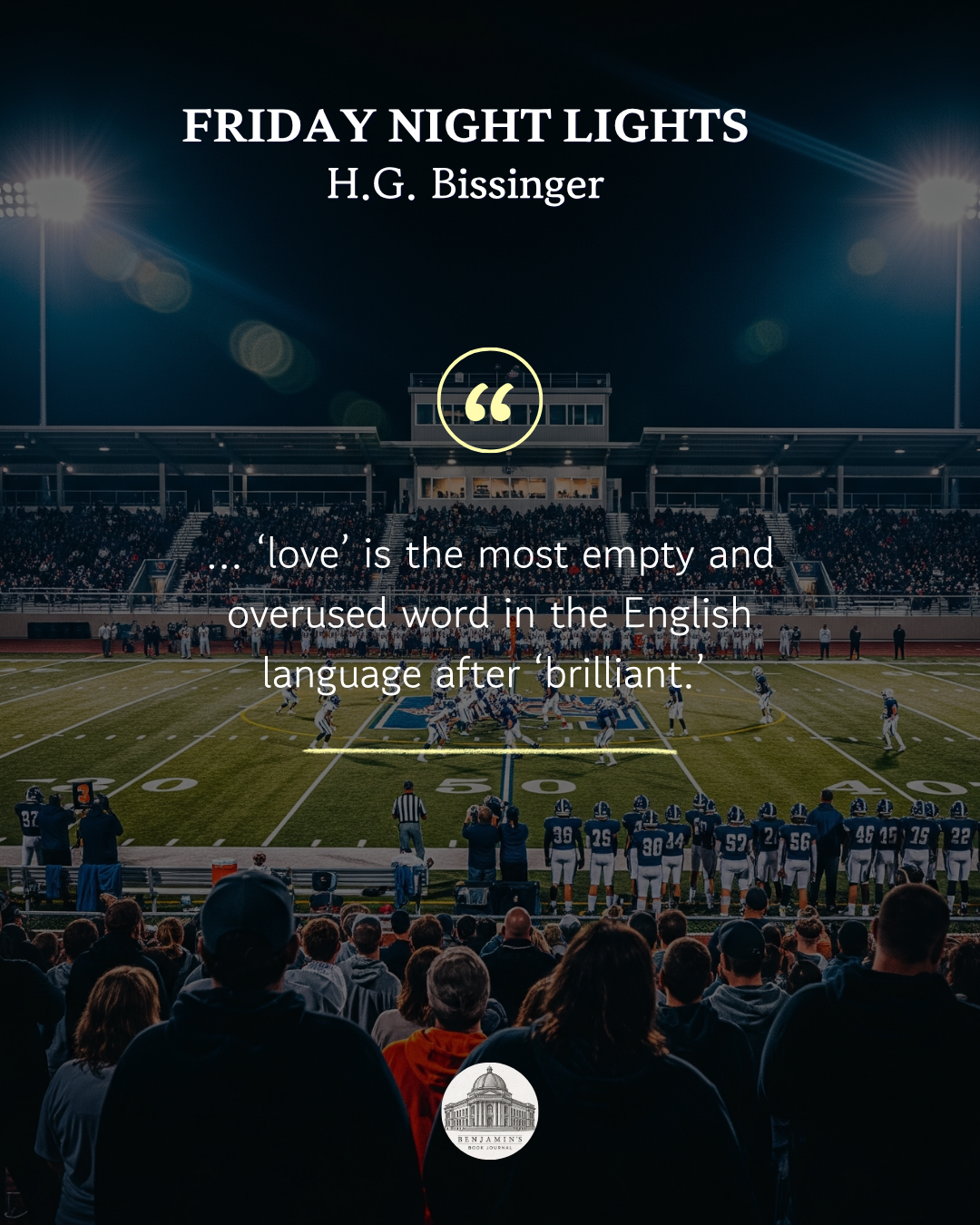
I had to know if there was still any emotional connection between us, if any of the power of what we went through still remained. I loved them then. But “love” is the most empty and overused word in the English language after “brilliant.” Twenty-five years earlier, I had gone in search of the Friday Night Lights. Now, during a week in April, in Texas, I went searching for those who had played under them.
(Bissinger 2015, 384)
When he wasn’t heaping abuse on himself, there had been something whimsical about Mike, a gift for making mischief. In what I thought was a seminal moment during the season, he asked me if I wanted to go snipe hunting. As a damn Yankee, I had no idea that snipes did not exist; the whole point was to drop off a naive idiot deep in the middle of nowhere and make him walk the long road home after he realized there were no such creatures. When Mike invited me, I considered it the breakthrough – I had finally broken the cultural barrier. It was only through the grace of an assistant coach that it was called off. “The farther the better,” Mike confessed now, “Show up with stitches and cactus sticking out of your butt. Well, you might be Ivy League but I’ve never seen a redneck fall that hard for the old snipe hunting trick.”
(Bissinger 2015, 385-386)
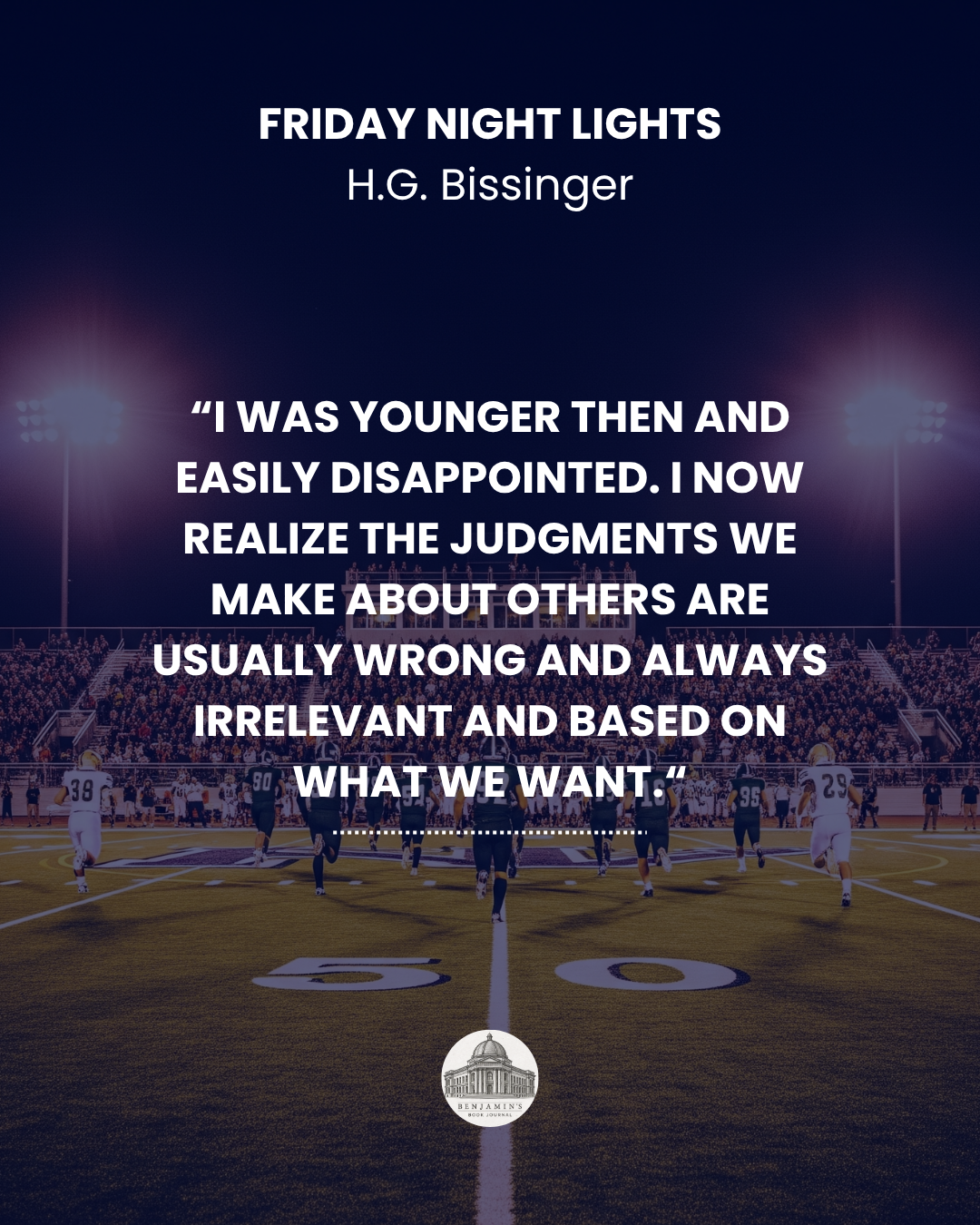
An exceptional academic opportunity came Mike’s way because of the book. An English professor at Austin College was so taken with him after reading it that he said the school would give him a full scholarship. The school, in Sherman, Texas, was private and small and highly regarded. At the time, I never understood why he didn’t truly pursue it. It bothered me. I was disappointed. I was younger then and easily disappointed. I now realize the judgments we make about others are usually wrong and always irrelevant and based on what we want.
(Bissinger 2015, 387)
References
Bissinger, H.G. 2015. Friday Night Lights, 25th Anniversary Edition: A Town, a Team, and a Dream. N.p.: Hachette Books.
ISBN 978-0-306-82421-0


 Benjamin’s Book Joural
Leave a comment