

The Battle for Japan, 1944-45
By Max Hastings
“Retributive justice” is among the dictionary definitions of nemesis. Readers must judge for themselves whether the fate of which befell Japan in 1945 merits that description, as I believe it does. The war in the Far East extended across an even wider canvas than the struggle for Europe: China, Burma, India, the Philippines, together with a vast expanse of the Pacific Ocean. Its courses were directed by one of the most extraordinary galaxies of leaders, military and political, the world has ever seen: Japan’s emperor, generals and admirals; Chiang Kai-shek and Mao Zedong; Churchill, Roosevelt, Truman, Stalin; MacArthur and Nimitz; LeMay, Slim, Mountbatten, Stilwell – and the men who built the bomb.
…
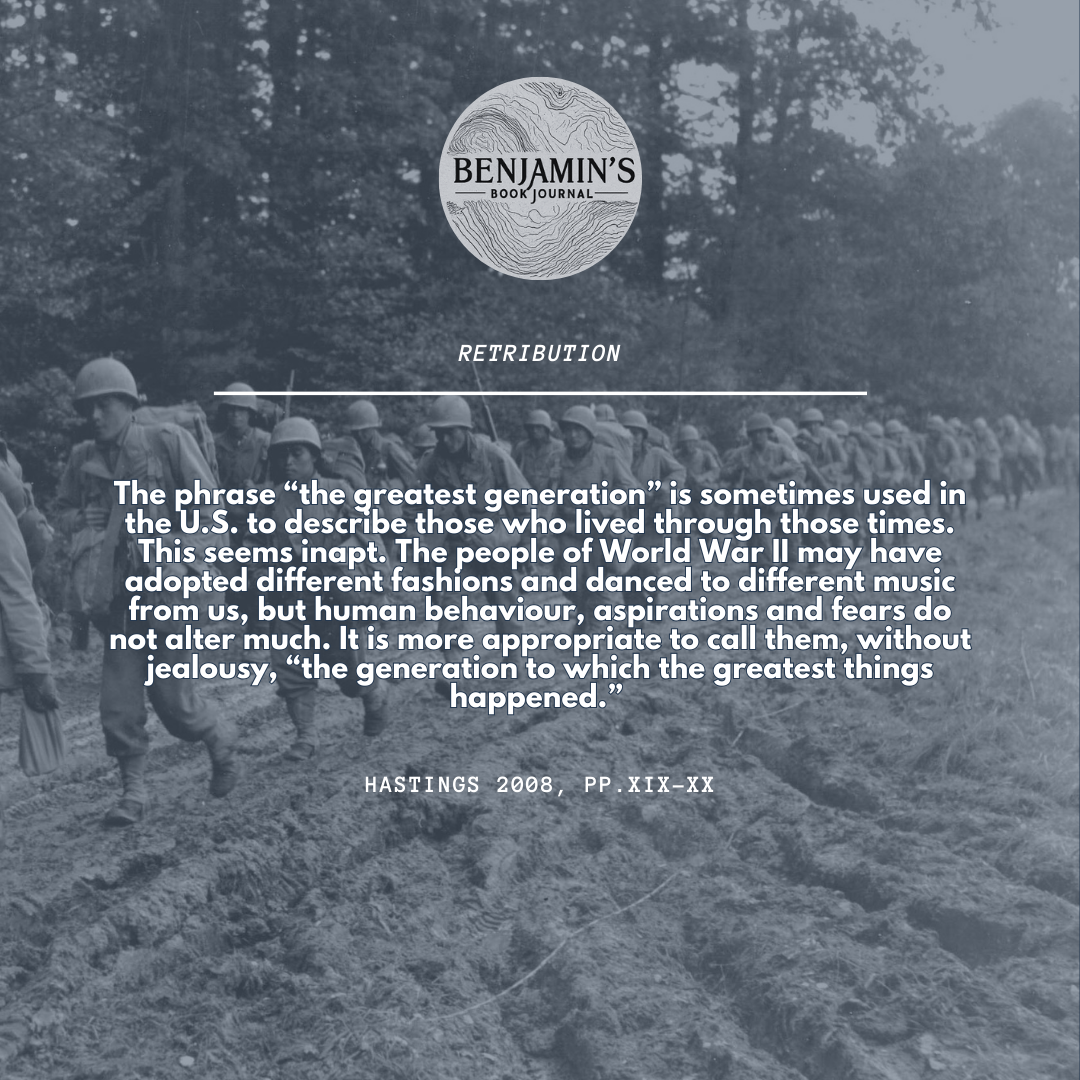
A host of innocent young men and a scattering of young women found themselves transplanted into a wildly exotic setting. The Pacific’s natural beauties provided inadequate compensation, alas, for the discomforts and emotional stresses which they endured amid coral atolls and palm trees. For every fighting soldier, sailor and Marine who suffered the terrors of battle, many more men experienced merely heat and boredom at some godforsaken island base. The phrase “the greatest generation” is sometimes used in the U.S. to describe those who lived through those times. This seems inapt. The people of World War II may have adopted different fashions and danced to different music from us, but human behaviour, aspirations and fears do not alter much. It is more appropriate to call them, without jealousy, “the generation to which the greatest things happened.”
(Hastings 2008, pp.xix-xx)
To soldiers, sailors and airmen, any battlefield beyond their own compass seemed remote. “What was happening in Europe really didn’t matter to us,” said Lt. John Cameron-Hayes of 23rd Indian Mountain Artillery, fighting in Burma. More surprising was the failure of Germany and Japan to coordinate their war efforts, even to the limited extent that geographical separation might have permitted. These two nominal allies, whose fortunes became conjoined in December 1941, conducted operations in almost absolute isolation from each other. Hitler had no wish for Asians to meddle in his Aryan war. Indeed, despite Himmler’s best efforts to prove that Japanese possessed some Aryan blood, Hitler remained embarrassed by the association of the Nazi cause the Untermenschen. He received the Japanese ambassador in Berlin twice after Pearl Harbor, then not for a year. When Tokyo in 1942 proposed an assault on Madagascar, the German navy opposed any infringement of the two allies’ agreed spheres of operations, divided at 70 degrees of longitude.
A Japanese assault on the Soviet Union in 1941-42, taking Russians in the rear as they struggled to stem Hitler’s invasion, might have yielded important rewards for the Axis. Stalin was terrified of such an eventuality. The July 1941 oil embargo and asset freeze imposed by the U.S. on Japan – Roosevelt’s clumsiest diplomatic act in the months before Pearl Harbor – was partly designed to deter Tokyo from joining Hitler’s Operation Barbarossa. Japan’s bellicose foreign minister, Yosuke Matsuoka, resigned in the same month because his government rejected his urgings to attack.
Only in January 1943, towards the end of the disaster of Stalingrad, did Hitler make a belated and unsuccessful attempt to persuade Japan to join his Russian war. By then, the moment had passed at which such an intervention might have altered history. Germany’s Asian ally was far too heavily committed in the Pacific, South-East Asia and China to gratuitously engage a new adversary. So perfunctory was Berlin’s relationship with Tokyo that when Hitler gifted to his ally two state-of-the-art U-boats for reproduction, German manufacturers complained about breaches of their patent rights. One of Japan’s most serious deficiencies in 1944-45 was lack of a portable anti-tank weapon, but no attempt was made to copy the cheap and excellent German Panzerfaust.
(Hastings 2008, pp.4-5)
Winston Churchill often asserted his conviction that the proper conduct of war demanded that “the enemy should be made to bleed and burn every day.” The Pacific and Burma campaigns, by contrast, were characterized by periods of intense fighting interspersed with long intervals of inaction and preparation. Whereas on the Russian front opposing forces were in permanent contact, and likewise in north-west Europe from June 1944, in the east Japanese and Allied troops were often separated by hundreds, even thousands, of miles of sea or jungle. Few Westerners who served in the war against Japan enjoyed the experience. It was widely agreed by veterans that the North African desert was the most congenial, or rather least terrible, theatre. Thereafter in ascending intensity of grief came north-west Europe, Italy, and finally the Far East. Few soldiers, sailore or airmen felt entirely healthy during Asian or Pacific service. The stifling heat belowdecks in a warship made daily routine enervating, even before the enemy took a hand. The only interruptions to months at sea were provided by brief spasms in an overcrowded rest camp on some featureless atoll. For those fighting the land campaigns, disease and privation were constants, vying as threats to a man’s welfare with a boundlessly ingenious and merciless enemy. “All the officers at home want to go to other theatres because there is more publicity there,” wrote one of MacArthur’s corps commanders, Lr. -Gen. Robert Eichelberger, in a gloomy letter to his wife.
(Hastings 2008, pp.11-12)
The British always acknowledged that their own forces and commanders performed poorly in the 1941-42 Burma and Malaya campaigns. Operations in the Philippines were equally mismanaged, but in those dark days Americans yearned for heroes. President and people colluded to make one of MacArthur, to forge a heroic myth around the defender of Bataan. Americans found it unthinkable that the U.S. army which slowly assembled in Australia through 1942 and 1943 should be led into battle by anyone else.
(Hastings 2008, pp.21)
For several decades after World War II, a legend was sedulously promoted, chiefly by the Japanese, of Hirohito’s long-standing pacifism. This view is now discredited. The emperor shared many of the army’s ambitions for his country, even if instinctive caution rendered him nervous of the huge risks which his generals embraced. Never until August 1945 did he speak or act with conviction against the excesses of “his” army. Hirohito indulged spasms of activism in vetoing appointments and initiatives. For the most part, however, he remained mute while successive governments pursued policies which not only brought his nation to disaster, but also earned it a reputation for barbarism quite at odds with the emperor’s own mild personality.
(Hastings 2008, pp.39-40)
By 1944, said Shigeru Funaki, “people understood that we were poorly prepared and equip[ped for a long war. I saw how important fuel was going to be to us. Because I had always enjoyed American movies, I knew what an advanced society America was. Yet we told each other that Americans were too democratic to be able to organise themselves for war. Many military men supposed that victory could be gained by fighting spirit alone. Out intelligence was never good, because few officers acknowledged its importance. Commanders understood the need for battlefield information, but not for strategic intelligence about the big picture.”
(Hastings 2008, pp.48)
In the Pacific there were no great battles resembling Normandy, the Bulge, the Vistula and Oder crossings, exploiting mass and manoeuvre. Instead, there was a series of violently intense miniatures, rendered all the more vivid in the minds of participants because they were so concentrated in space. Such contests as that for Peleliu were decided by the endeavours of footsoldiers and direct support weapons, notably tanks. This was a battle fought on Japanese terms. Like others that would follow in the months ahead, it suited their temperament, skills and meagre resources. The defenders of Peleliu possessed no means of withdrawing, even had they wished to do so. Their extinction therefore required a commitment of flesh against flesh, the sacrifice of significant numbers of American lives. The U.S., whose power seemed so awesome when viewed across the canvas of global war, found itself unable effectively to leverage this in battles of bloody handkerchief proportions, such as that for Peleliu.
(Hastings 2008, pp.119)
Yet, from beginning to end of the Leyte battle, perverse psychological forces were in play. The Japanese had embarked on the Shogo operation anticipating the worst. At every turn they behaved with the fatalism of doomed men, convinced of their own inferiority to the enemy. Kurita and his captains expected to be attacked and sunk by carrier aircraft, and here indeed were carrier aircraft. They anticipated a disastrous encounter with the U.S. Third Fleet, and here it seemed to be. A weak and vulnerable American force, Taffy 3, was under assault by one of the most powerful battle squadrons in the world. Yet Kurita and his captains assumed that they faced defeat. It remains an enigma how by October 1944 the fighting seamen of the Japanese navy had been reduced to such poverty of thought, will and action. This was the force which conceived and executed the attack on Pearl Harbor, which destroyed the British capital ships Prince of Wales and Repulse, which performed miracles of skill and daring in the early years of war. Yet now the commanders of Japan’s greatest warships revealed stunning ineptitude. On 25 October their ship recognition was inept, their tactics primitive, their gunnery woeful, their spirit feeble. None of this diminishes the American achievement that day, but it invites the bewilderment of history.
(Hastings 2008, pp.153)
It is an important truth about war that soldiers on shore, and pilots aloft, almost always have some personal choice about whether to be brave. By contrast, sailors crewing a warship are prisoners of the sole will of their captain. On 25 October 1944, it is no libel upon the crews of Taffy 3’s escorts to suggest that some must have been appalled. They were conscripted as heroes, borne at high speed towards an overwhelmingly powerful enemy.
(Hastings 2008, pp.154)
Among sailors, Halsey incurred much heavier criticism for another blunder two months later, when he kept his fleet at sea after a typhoon was forecast. When this came, it sank three destroyers, crippled many other ships, and drowned almost eight hundred men. By contrast, Halsey’s Leyte Gulf blunder was redeemed by the follies of Kurita. The night action of Oldendorf’s battleships, cruisers, destroyers and PT-boats in the Surigao Strait was a set piece in the best traditions of the U.S. Navy. Less spectacular, yet at least as significant, was the achievement of American damage-control parties. “Prosecute damage control measures with utmost diligence and tenacity. Don’t give up the ship!” decreed the navy’s 1944 Tactical Orders and Doctrine. The men of the USN fulfilled this injunction with extraordinary devotion and sacrifice. On ship after ship at Leyte, they achieved miracles amidst flaming fuel and twisted wreckage, dying men and choking smoke. Damage control was an outstanding aspect of U.S. naval performance, enabling vessels to be saved from destruction which, in other navies or at an earlier phase of the war, would have been doomed.
(Hastings 2008, pp.163)
It can be argued, in the spirit of the Royal Navy’s staff study, that only a narrow line separated the deeds of Japan’s suicide pilots from the sort of actions for which the Allies awarded posthumous Medals of Honor and Victoria Crosses. A significant number of American and British sailors, fliers and soldiers were decorated after their deaths for hurling themselves upon the enemy in a fashion indistinguishable from that of the kamikazes. But Western societies cherish a distinction between spontaneous individual adoption of a course of action which makes death probable, and institutionalisation of a tactic which makes it inevitable. Thus, the Allies regarded the kamikazes with unfeigned repugnance as well as fear. In the last months of the war, this new terror prompted among Americans an escalation of hatred, a diminution of mercy.
(Hastings 2008, pp.172)
China’s wartime sufferings, which remain unknown to most Westerners, were second in scale only to those of the Soviet Union. It is uncertain how many Chinese died in the years of conflict with Japan. Traditionally, a figure of fifteen million has been accepted, one-third of these being soldiers. Modern Chinese historians variously assert twenty-five, even fifty million. Ninety-five million people became homeless refugees. Such estimates are neither provable nor disprovable. Rather than being founded upon convincing statistical analysis, they reflect the intensity of Chinese emotions about what the Japanese did to their country. What is indisputable is that a host of people perished. Survivors suffered horrors almost beyond our imaginings. Massacre, destruction, rape and starvation were the common diet of the Chinese people through each year of Japan’s violent engagement in their country.
Historians of Asia assert that the Second World War properly began in China, rather than Poland. In 1931 Japan almost bloodlessly seized Manchuria – the north-eastern Chinese provinces, an area twice the size of Britain, with a population of thirty-five million people, ruled by an old warlord – to secure its coal, raw materials, industries and strategic rail links. The Nationalist government based in Nanjing was too weak to offer resistance. The following year, Tokyo announced Manchuria’s transformation into the puppet state of Manchukuo, nominally ruled by the Manchu Emperor Pu Yi, in practice by a Japanese-controlled prime minister, and garrisoned by Japan’s so-called Guandong Army. The Japanese perceived themselves as merely continuing a tradition established over centuries by Western powers in Asia – that of exploiting superior might to extend their home industrial and trading bases.
(Hastings 2008, pp.192-193)
Political power in China was attainable only with the support of bayonets. Chiang exploited his skills as a military organiser to become the most powerful of all warlords, also having pretensions to a revolutionary ideology. “Fascism is a stimulant for a declining society,” he declared in an address to his “Blue Shirt” followers in 1935. “Can fascism save China? We answer: ‘Yes.’ “ He described liberal democracy as “a poison to be expelled from the country’s body politic.” Yet his professed Christianity and enthusiasm for the West caused many Americans to overlook the absolutism, brutality and corruption of his regime. Thus, for instance, former China medical missionary Congressman Walter Judd in 1944, comparing Americans and Chinese: “The two peoples are nearer alike, we are nearer to the Chinese in our basic beliefs, our basic emphasis on the rights of the individual, and in our basic personal habits of democracy, than we are to most of the countries of Europe.”
Indian political leaders admired Chiang as a nationalist, and applauded his outspoken opposition to colonialism. Nehru and the Congress Party described him as “the great leader.” Many modern Chinese scholars are far less dismissive of Chiang than might be expected. Yang Jinghua, a historian of Manchuria who has been a Communist Party member for more than thirty years, today regards the generalissimo as a great man: “We say about Mao that he was 30 percent wrong, 70 percent right. Despite the fact that Chiang was a profoundly corrupt dictator, I would say the same about him.” Such assertions do not signify that Chiang Kai-shek was a successful or admirable ruler; merely that some of his own people retain respect towards his aspirations for a modern, unified China.
Many Japanese politicians and soldiers learned to regret their entanglement in China as they struggled to stem the American tide in the Pacific. Occupation delivered nothing like the economic benefits which the invaders had expected. Had the huge Japanese forces committed in China – amounting to 45 percent of the army even in 1945 – been available for service elsewhere, they might have made an important contribution. That year, Hirohito and army chief of staff Field Marshal Hajime Sugiyama held a conversation which became legendary. The emperor enquired why the China war was taking so long to finish. “China is bigger than we thought,” said Sugiyama. Hirohito observed: “The Pacific is also big.” In 1943 or 1944, Tokyo would have been happy to withdraw from most of China if the Nationalists had been willing to abandon hostilities and concede Japanese hegemony in Manchuria. This, however, Chiang would never do. And as America’s commitment in China grew, the Japanese could not permit U.S. forces or their Nationalist clients to gain control of the coastline. They perceived no choice save to use a million soldiers to hold their ground.
(Hastings 2008, pp.200-201)
It is a striking feature of the Second World War that the populist media of the democracies made stars of some undeserving commanders, who thereafter became hard to sack. MacArthur’s Philippines campaign did little more to advance the surrender of Japan than Slim’s campaign in Burma, and was conducted with vastly less competence. Its principal victims were the Philippine people, and MacArthur’s own military reputation. Before the landing at Leyte, this stood high, probably higher than it deserved, following the conquest of Papua New Guinea. The early blunderings of that campaign were forgotten, and the general received laurels for the daring series of amphibious strokes which achieved victory. In the Philippines, however, instead of achieving the cheap, quick successes he had promised, his forces became entangled in protracted fighting, on terms which suited the Japanese. MacArthur’s contempt for intelligence was a persistent, crippling defect. On Luson, where he sought to exercise personal field command, his opponent Yamashita displayed a nimbleness in striking contrast to the heavy-footed advance of Sixth Army. Stanley Falk has written of MacArthur: “On those occasions when the Japanese faced him with equal or greater strength, he was unable to defeat them or to react swiftly or adequately to their initiatives.” “The … South-West Pacific commitment was an unnecessary and profligate waste of resources, involving the needless loss of thousands of lives, and in no significant way affecting the outcome of the war.”
Japanese barbarism rendered the battle for Manila a human catastrophe, but MacArthur’s obsession with seizing the city created the circumstances for it. The U.S. lost 8,140 men killed on Luzon. Around 200,000 Japanese died there, many of disease. If the exchange ran overwhelmingly in America’s favour, those same enemy forces could have gone nowhere and achieved nothing had the Americans contented themselves with their containment. SWPA’s supreme commander compounded his mistakes by embarking upon the reconquest of the entire Philippines Archipelago, even before Luzon had fallen. MacArther presided over the largest ground campaign of America’s war in the Pacific in a fashion which satisfied his own ambitions more convincingly than the national purposes of his country.
(Hastings 2008, pp.145-146)
When Marine veterans got back to Hawaii, one group marched triumphantly down the street waving a Japanese skull and taunting local Japanese-Americans: “There’s your uncle on the pole!” The experience of Iwo Jima had drained some survivors of all human sensitivity. Was the island worth the American blood sacrifice? Some historians highlight a simple statistic: more American aircrew landed safely on its airstrips in damaged or fuelless B-29s than Marines died in seizing it. This calculation of profit and loss, first offered after the battle to assuage public anger about the cost of taking Iwo Jima, ignores the obvious fact that, if the strips had not been there, fuel margins would have been increased, some aircraft would have reached the Marianas, some crews could have been rescued from the sea. Even if Iwo Jima had remained in Japanese hands, it could have contributed little further service to the homeland’s air defence. The Americans made no important use of its bases for offensive operations.
Yet to say this is to ignore the fact that in every campaign in every war, sacrifices are routinely made that are out of all proportion to the significance of objectives. Unless Nimitz had made an implausible decision, to forgo land engagement while the army fought for the Philippines, to await the collapse of the enemy through bombing, blockade, industrial and human starvation, the assault on Iwo Jima was almost inevitable. Whether wisely or no, the enemy valued the island, and took great pains for its defence. It would have required a strategic judgement of remarkable forbearance to resist the urge to destroy the garrison of the rock, a rare solid foothold in the midst of the ocean. If some historians judge that America’s warlords erred in taking Iwo Jima, the commitment seemed natural in the context of the grand design for America’s assault on the Japanese homeland.
(Hastings 2008, pp.264-265)
When the war ended, it became possible to compare the fates of Allied servicemen under the Nazis and the Japanese. Just 4 percent of British and American POWs had died in German hands. Yet 27 percent – 35,756 out of 132,134 – of Western Allied prisoners lost their lives in Japanese captivity. The Chinese suffered in similar measure. Of 41,862 sent to become slave labourers in Japan, 2,872 died in China, 600 in ships on passage, 200 on the land journey, and 6,872 in their Japanese workplaces. These figures discount a host of captives who did not survive in Japanese hands on the battlefield, or after being shot down, for long enough to become statistics.
Of 130,000 Europeans interned in the Dutch East Indies, almost all civilians, 30,000 died, including 4,500 women and 2,300 children. Of 300,000 Javanese, Tamils, Burmans and Chinese sent to work on the Burma-Siam railway, 60,000 perished, likewise a quarter of the 60,000 Western Allied prisoners. There seemed no limit to Japanese inhumanity. When a cholera epidemic struck Tamil railway workers at Nieke in June 1943, a barracks containing 250 infected men, women and children was simply torched. One of the Japanese who did the burning wrote later of the victims: “I dared not look into their eyes. I only heard some whispering ‘Tolong, tolong’ – ‘Help, help.’ It was the most pitiful sight. God forgive me. I was not happy to see them being burnt alive.”
To give a British illustration: when the Royal Navy destroyer Encounter was sunk in the 1942 Battle of the Java Sea, 123 of its crew lived to enter captivity. Of these, 41 were lost when a transport carrying them to Japan was sunk by an American submarine; 30 died in POW camps; just 52 returned to England in 1945. This represented a saga of systematic deprivation and brutality, overlaid upon the hazards of war, of a kind familiar to Russian and Jewish prisoners of the Nazis, yet shocking to the American, British and Australian publics. It seemed incomprehensible that a nation with pretensions to civilisation could have defied every principle of humanity and the supposed rules of war. The saga of Japan’s captives has exercised a terrible fascination for Westerners ever since.
(Hastings 2008, pp.346-347)
Some German prisoners – sensationalists claim tens of thousands – died in Allied hands in north-west Europe in the summer of 1945, chiefly because the administrative machinery was overwhelmed by their numbers. This was an argument advanced to justify some POW deaths in Japanese hands in 1942. Nobody in London or Washington, however, troubled to investigate the fate of abused German or Japanese prisoners, far less to frame indictments against Allied personnel. In the nature of military affairs, those selected to guard POWs are among the least impressive material in every nation’s armed forces. None of this represents an attempt to suggest moral equivalence between Japanese treatment of Allied POWs and the other way around; merely that few belligerents in any war can boast unblemished records in the treatment of prisoners, as events in Iraq have recently reminded us.
(Hastings 2008, pp.366-367)
Any society which can indulge such actions, whether or not as alleged acts of retribution, has lost its moral compass. Much Japanese behaviour reflected the bitterness of former victors about finding their own military fortunes in eclipse, becoming the bombed instead of the bombers. More than sixty years later, there still seems no acceptable excuse. The Japanese, having started the war, waged it with such savagery towards the innocent and important that it is easy to understand the rage which filled Allied hearts in 1945, when all was revealed. The ambivalence of post-war Japan about its treatment of captives is exemplified in the 1952 memoirs of wartime foreign minister Mamoru Shigemitsu, one of the more rational of wartime foreign minister Mamoru Shigemitsu, one of the more rational of the country’s leaders. He wrote: “After the war many instances were recorded of kindly treatment by Japanese in individual cases, and a number of letters of thanks were received from ex-prisoners of war and persons who had been in concentration camps.” Shigemitsu tarnished his own reputation by penning such pitiful stuff. War is inherently inhumane, but the Japanese practiced extraordinary refinements of inhumanity in the treatment of those thrown upon their mercy.
(Hastings 2008, pp.368)
John Paton Davies and his kind forever afterwards believed that, in the winter of 1944-45, the United States lost a historic opportunity to achieve an understanding with China’s future, in the person of Mao, which it sacrificed by clinging to the past, in the person of Chiang. This was naive. There is no more reason to suppose that Mao would have honoured promises to American capitalists, made under the duress of war, than did Chiang. Both were playing a game with the Americans, Chiang with greater apparent success, Mao with much shrewder understanding of his own people. Edgar Snow, the U.S. journalist who knew Mao for many years and who became one of his most effective Western propagandists, recorded a conversation with him in the 1930s: “Both of us felt a growing conviction that the Commubnist-Nationalist war in China would in the long term prove more important than the Japanese war … Mao correctly predicted the Japanese attack on Western colonies in Asia, Russian intervention in a general war to defeat the Japanese – and end colonialism in Asia. He told me to expect the Japanese to win all the great battles, seize the main cities and communications, and in the process destroy the KMT’s best forces … at the end of a war which he thought might last ten years, the ‘forces of the Chinese revolution’ would … emerge as the leading power in East Asia.”
This seems both a plausible illustration of Mao Zedong’s shrewdness and a convincing view of his agenda. In 1945, the U.S. remained implacably unwilling to send military aid to Yan’an. For this, much abuse has been heaped upon Hurley and his kind by liberal contemporaries and historians. Yet the Americans were surely right. It would have availed the Allied war effort nothing to ship arms to the Communists. These would have been used against the Japanese only in showcase operations to impress foreign spectators. By now, the minds of U.S. policy-makers as well as Chinese principals had become fixed upon shaping post-war realities, rather than promoting Japan’s defeat on the Asian mainland.
(Hastings 2008, pp.423)
Some historians have perceived in Byrnes’s attitude a petty nationalism unworthy of the issues at stake. It may be true that he was an unsophisticated man, smaller than his great office, as Truman later decided him to be. Yet if Byrnes’s judgements in the summer of 1945 were strongly influenced by domestic political considerations, they do not seem unreasonable. The U.S. was Japan’s principal enemy. Throughout the war, the Soviet Union had shown itself obsessively fearful that the Western Allies might make a separate peace with Germany. Britain and the U.S. deferred to Soviet paranoia – rejecting, for instance, every approach from German anti-Nazis until the last days when Hitler’s armies in Italy surrendered. Now, Tokyo had chosen to approach Moscow. At a time when Soviet savagery and expansionism in Europe were shocking the world, why should not the U.S. spurn such contortions? Those who criticise America’s alleged failure to reach out to the enemy in the last weeks of July 1945, to save the Japanese from themselves, seem to neglect a simple point. If Tokyo wanted to end the war, the only credible means of doing so was by an approach to Washington, through some neutral agency less hopelessly compromised than the Soviet Union.
We know why this did not happen: because the Japanese expected to gain more favourable terms from the Russians; and because the war party in Tokyo would have vetoed direct negotiation with the United States. The loss of face would have been unendurable. The State Department’s Asian experts thoroughly understood the cultural and political forces which caused the Japanese to behave as they did. When, however, America stood on the brink of absolute victory over a nation which had brought untold grief and misery upon Asia, why should not the enemy bear the burden of acknowledging his condition, and indeed his guilt?
Hitler set a standard of evil among those whom the allies fought in the Second World War. Some historians, not all of them Japanese, argue that Japan’s leaders represented a significantly lesser baseness; and certainly not one which deserved the atomic bomb. Few of those Asians who experienced Japanese conquest, however, and knew of the millions of deaths which it encompassed, believed that Japan possessed any superior claim on Allied forbearance to that of Germany. Post-war critics of U.S. conduct in the weeks before Hiroshima seem to demand from America’s leaders moral and political generosity so far in advance of that displayed by their Japanese counterparts as to be fantastic, in the sixth year of a global war. Their essential thesis is that America should have spared its enemies from the human consequences of their own rulers’ blind folly; that those in Washington should have displayed a concern for the Japanese people much more enlightened than that of the Tokyo government.
Why, however, should the U.S. either have welcomed a Soviet propaganda triumph in Asia, or humoured the self-esteem of a barbarous enemy? Tuman’s “firmness” towards Japan certainly reflected a desire to impress his authority upon the Soviets, as well as upon the American people. Yet is is hard to believe that Roosevelt, architect of the doctrine of unconditional surrender, would have behaved much differently, had he survived. In the war against Germany, Stalin took much in return for paying most of the blood cost of victory. He profited from overrunning eastern Europe while the British and Americans dallied west of the Rhine. In irksome to see the Soviets on the brink of garnering rich rewards for attending curtain calls after missing all but the last minutes of the play. The principal and overwhelming reason for dropping the bomb was to compel the Japanese to end the war; but it seems entirely reasonable that the U.S. also wished to frustrate Soviet expansionism.
James Byrnes wrote in his memoirs: “Had the Japanese government surrendered unconditionally, it would not have been necessary to drop the atomic bomb.” Tsuyoshi Hasegawa, author of one of the more significant recent studies of this period, comments: “Perhaps this statement can be read in reverse: ‘If we insisted on unconditional surrender, we could justify the dropping of the atomic bomb.’ “ Hasegawa’s words again prompt the question: why should the U.S. not have insisted upon unconditional surrender?
(Hastings 2008, pp.461-463)
From the inception of the Manhattan Project, it was assumed by all but a few scientists that if the device was successful, it would be used. Some people today, especially Asians, believe that the Allies found it acceptable to kill 100,000 Japanese in this way, as it would not have been acceptable to do the same to Germans, white people. Such speculation is not susceptible to proof. But given Allied perceptions that if Hitler and his immediate following could be removed, Germany would quickly surrender, it is overwhelmingly likely that if an atomic bomb had been available a year earlier, it would have been dropped on Berlin. It would have seemed ridiculous to draw a moral distinction between massed attacks on German centres of population by the RAF and USAF with conventional weapons, and the use of a single more ambitious device to terminate Europe’s agony.
(Hastings 2008, pp.474)
In the light of the events of August 1945, it can be suggested that Japan would have surrendered not one day later had U.S. ground forces never advanced beyond their capture of the Marianas in the summer of 1944. It is superficially arguable, therefore, that Iwo Jima, Okinawa and MacArthur’s Philippines campaign contributed no more than did Slim’s victory in Burma to the final outcome. The Japanese retained large armies with which to defend their home islands. They were induced to quit by fuel starvation, the collapse of industry caused by blockade and in lesser degree aerial bombardment, together with the Soviet invasion of Manchuria and the atomic bombs.
(Hastings 2008, pp.542)
Of the atomic bombs, a modern American historian has written: “If the bombing of Hiroshima and Nagaski was the apogee of the nation-state – for what other political entity could possibly have financed and manned such an undertaking as the Manhattan Project … then that moment was also the birth of the universal vulnerability of the nation-state.” Not only does the use of the atomic bombs seem to have been justified in the circumstances prevailing in August 1945, but I am among those convinced that the demonstration of nuclear horror, and the global revulsion which it provoked, has contributed decisively towards preserving the world since. It the effects of nuclear attack had not been demonstrated at Hiroshima and Nagasaki, it is overwhelmingly likely that in the Cold War era, an American or Russian leader would have convinced himself that the use of atomic weapons could be justified. Korea in 1950 offers an obvious example, when some U.S. generals, above all MacArthur, favoured exploiting against China the advantages supposedly conferred by America’s nuclear arsenal. Such a point is irrelevant to the debate about whether the original decision in 1945 was valid, but is surely worthy of consideration more than six decades later.
(Hastings 2008, pp.534)
Germany has paid almost $6 billion to 1.5 million victims of the Hitler era. Austria has paid $400 million to 132,000 people. By contrast, modern Japan goes to extraordinary lengths to escape any admission of responsibility, far less of liability for compensation, towards its wartime victims. By an absurd, indeed grotesque, irony, in 1999 the British government chose to make ex-gratia payments to British former captives of the Japanese, having despaired of the perpetrators of their sufferings doing so. Repeated attempts at litigation before Japanese judges, notably by Chinese plaintiffs including former “comfort women,” have so far been unsuccessful. Three cases have only recently been rejected by the Supreme Court. Perhaps the most striking example is that of slave labourers, of whom 38,935 Chinese were shipped to Japan, and 6,830 died. They were employed by thirty-five companies, of which twenty-two continue to trade, including Mitsubishi and Mitsui Mining. In a recent lawsuit by former Chinese slaves against Mitsubishi, defence lawyers sought to question whether Japan had invaded China. Mitsubishi explicitly denies that it employed forced labour. A ruling in favor of the plaintiffs, said Mitsubishi’s counsel, would “impose an unjust burden on future generations of our nation, possibly for centuries to come.”
(Hastings 2008, pp.549)
References
Hastings, Max. 2008. Retribution: The Battle for Japan, 1944-45. N.p.: Alfred A. Knopf.
ISBN 978-0-307-26351-3


 Benjamin’s Book Journal
Leave a comment