

His Words for Our Times
Edited by Edwin O. Guthman & C. Richard Allen
For a certain kind of Irishman – and I am that certain find – Robert F. Kennedy is our spiritual godfather.
In many homes in Ireland, the Kennedys were on the same shelf as the pope. From my father’s point of view, the Kennedys were Ireland’s revenge on the royal family. That’s right – it took America to produce an Irish royal family. [Bono]
(Kennedy 2018, pp.9)
Robert Kennedy understood this necessity and championed during his campaign the vision of Teddy Roosevelt and others before him. In Colombia, we believed that peace must be achieved first, and most importantly, with nature, because “the earth’s resources are not a gift from our fathers but a loan from our children.” [Juan Manuel Santos]
(Kennedy 2018, pp.24)
The four articles [written for the Boston Post] not only marked his entry into the arena of public affairs but also foretold what kind of an observer and writer he would be: strong-minded, specific, and perceptive. At a time when leading diplomats in America and around the world doubted a Jewish state was needed or could survive, he wrote that the Jews would win the war and establish “a truly great modern example of the birth of a nation in dignity and self-respect.” He did not anticipate that similar yearnings among Palestinians would remain unsatisfied seven decades after his visit.
(Kennedy 2018, pp. 36)
There have been many jokes directed at politics. I remember the wisecrack many years ago in Boston that my grandfather John Fitzgerald would still be mayor of Boston if someone hadn’t broken into the courthouse and stolen the election returns for the next ten years.
But the time is important for us to rise in defense of politics. There is no greater need than for educated men and women to point their careers toward public service as the finest and most rewarding type of life. There is a great danger, not only in politics but in many facets of our nation’s social and economic life, that the ethical and moral approach has been reduced to the second rank importance behind the twin goals of success and prosperity. If this is generally true – and there are many indications that it is – then our nation is in dire peril at a time when its foundations should be strongest.
(Kennedy 2018, pp.56-57)
The decisions of the courts, however much we might disagree with them, in the final analysis must be followed and respected. If we disagree with a court decision and thereafter irresponsibly assail the court and defy its rulings, we challenge the foundations of our society.
I wonder in how many countries of the world people think of law as the “link between man and freedom.” We know that in many, law is the instrument of tyranny, and people think of law as little more than the will of the state or the party – not of the people.
And we know too that throughout the long history of mankind, man has had to struggle to create a system of law and of government in which fundamental freedoms would be linked with the enforcement of justice. We know that we cannot live together without rules which tell us what is right and what is wrong, what is permitted and what is prohibited. We know that it is law which enables man to live together, that creates order out of chaos. We know that the law is the glue that holds civilization together.
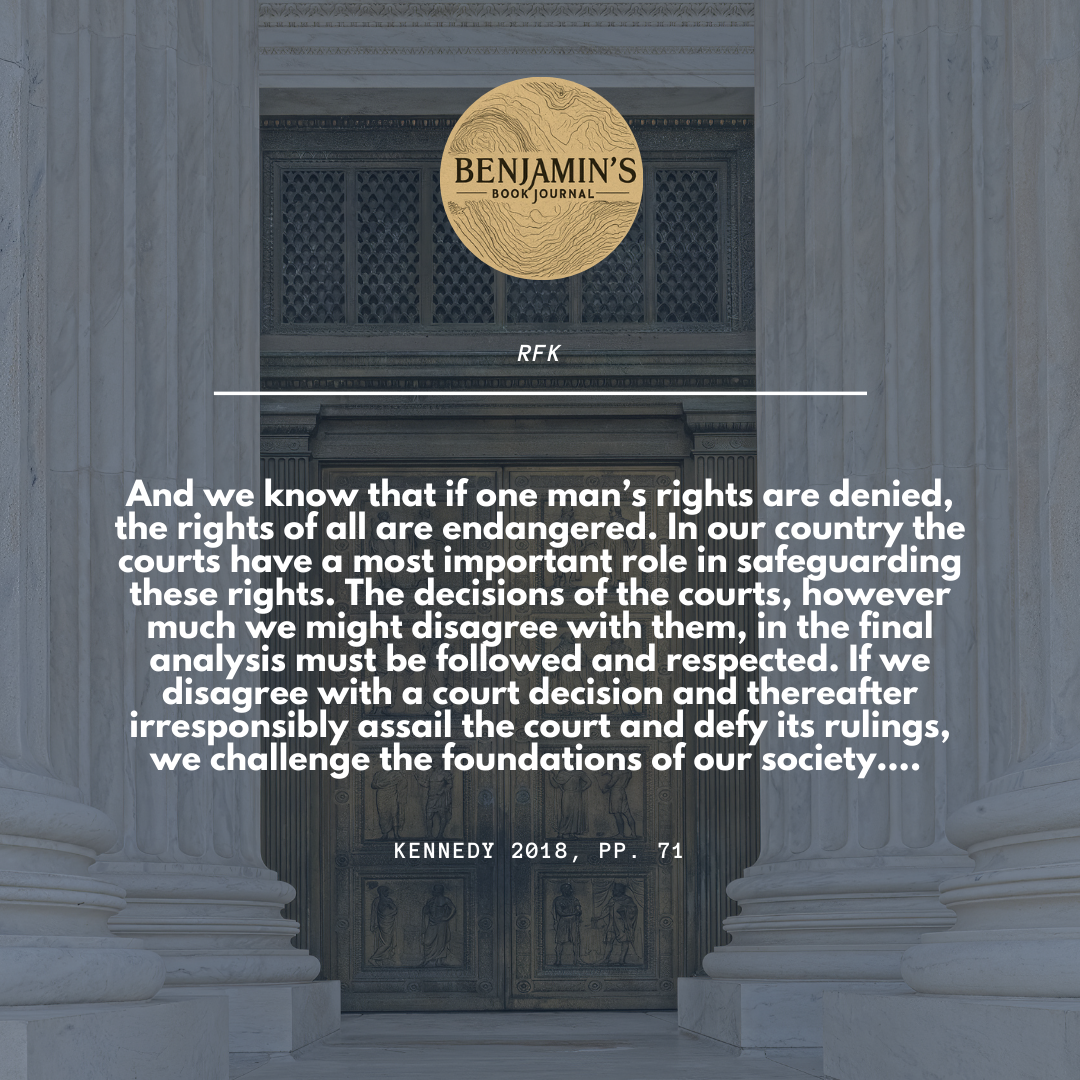
And we know that if one man’s rights are denied, the rights of all are endangered. In our country the courts have a most important role in safeguarding these rights. The decisions of the courts, however much we might disagree with them, in the final analysis must be followed and respected. If we disagree with a court decision and thereafter irresponsibly assail the court and defy its rulings, we challenge the foundations of our society….
(Kennedy 2018, pp. 71)
Miscalculation and misunderstanding and escalation on one side bring a counter-response. No action is taken against a powerful adversary in a vacuum.
The final lesson of the Cuban Missile Crisis is the importance of placing ourselves in the other country’s shoes. During the crisis, President Kennedy spent more time trying to determine the effect of a particular course of action on Khrushchev or the Russians than on any other phase of what he was doing. What guided all his deliberations was an effort not to disgrace Khruschev, not to humiliate the Soviet Union, not to have the feel they would have to escalate their response because their national security or national interests so committed them.
That is why he was so reluctant to stop and search a Russian ship; this was why he was so opposed to attacking the missile sites. The Russians, he felt, would have to react militarily to such actions on our part.
Thus the initial decision to impose a quarantine rather than to attack; our decision to permit the Bucharest to pass; our decision to board a non-Russian vessel first; all these and many more were taken with a view to putting pressure on the Soviet Union but not causing a public humiliation.
Miscalculation and misunderstanding and escalation on one side bring a counter-response. No action is taken against a powerful adversary in a vacuum. A government or people will fail to understand this only at their great peril. For that is how wars begin – wars that no one wants, no one intends, and now one wins.
(Kennedy 2018, pp.103)
A white person, traveling in a part of the country where discrimination is customary, can make reservations in advance or stop for food and lodging where and when he will.
For the Negro it is not so simple. If he makes reservations without first determining whether or not the establishment will accept people of his race, he may well find on his arrival that the reservation will not be honored – or that it will somehow have been mislaid. His alternative is to subject himself or his family to the humiliation of rejection at one establishment after another – until, as like as not, he is forced to accept accommodations of inferior quality, far removed from his route of travel.
White people of whatever kind – even prostitutes, narcotics pushers, Communists, or bank robbers – are welcome at establishments which will not admit certain of our federal judges, ambassadors, and countless members of our armed forces … If Congress can, and does, control the service of oleomargarine in every restaurant in the nation, surely it can insure our nonwhite citizens access to those restaurants. [He then listed thirty-eight federal statutes, based on the commerce clause of the Constitution, that regulate private businesses and property.]
(Kennedy 2018, pp.108)
our young people are our greatest natural resource
As we stand here today, brave young men are fighting across an ocean. Here, while the sun shines, men are dying on the other side of the earth.
Which of them might have written a great symphony? Which of them might have cured cancer? Which of them might have played in a World Series or given us the gift of laughter from a stage or helped build a bridge or a university? Which one of them would have taught a child to read?
It is our responsibility to let those men live. If they die because of our empty vanities, because of our failure of wisdom, because the world has changed and we have not changed with it, then we must answer to them.
And we must also answer to mankind.
We are the great country of diversity. There is room here for everyone. But our young people are our greatest natural resource …
We must bring them back into American life.
(Kennedy 2018, pp.357)
The worst thing we could do would be to take as our mission the suppression of disorder or of internal upheaval everywhere it appears.
The limitation has, in fact, been forced to our attention. For one thing, Vietnam has proven that all the might and power of America cannot provide or create a substitute for another government, or for the will of another people. But let us understand the full significance of the limitation I suggest. It does not prevent us from aiding any nation against truly external aggression. It does not prevent us from extending reasonable assistance to developing nations. It does prevent us from taking over an internal struggle for a minority government or a government too ineffective or corrupt to gain the support of its own people. It would allow the future of each country to be settled, essentially, by the people of that country…
Even within the nations once ruled by Moscow, the forces of national independence and personal freedom are steadily eroding the Soviets’ once-unquestioned position. That force can be our strongest ally in the world, if we respect and honor it. It can also be our nemesis, if we continue to ignore it.
The worst thing we could do would be to take as our mission the suppression of disorder or of internal upheaval everywhere it appears. This is even more true if it means for this policeman’s role is to be the indiscriminate introduction of American troops into the internal struggles of other nations.
(Kennedy 2018, pp.389-390)
Jobs were better than welfare, because welfare created dependency and work conferred self-respect; we had to be tough on crime; riots were no solution to the problems
The Indiana primary presented a significant political dilemma in this regard: The state was predominantly conservative and overwhelmingly white. Some members of the press corps accused Kennedy of tailoring his message to emphasize his crime-fighting credentials with white audiences in Indiana, but a review of the record bears out the consistency of his message. Journalist Jack Newfield remembered one typical day, during a motorcade
Through the racially divided and tense steel town of Gary. The black mayor, Richard Hatcher, was balanced on one side of Kennedy, and Tony Zale, the Slavic warrior who came out of Gary’s blast furnaces to twice win the middleweight boxing championship, was braced on the other side of the candidate. The open cars rode through the white part of Gary, and then the black part, and Kennedy said precisely the same thing to both races: Jobs were better than welfare, because welfare created dependency and work conferred self-respect; we had to be tough on crime; riots were no solution to the problems … The reaction was equally enthusiastic in each half of the city.
(Kennedy 2018, pp.393-394)
the fight against crime is in the last analysis the same as the fight for equal opportunity, or the battle against hunger and deprivation, or the struggle to prevent the pollution of our air and water
Crime is an issue that is difficult and dangerous; easily susceptible to illusory promises and false programs; an issue which threatens to divert us from the road to a better nation into blind alleys of suspicion and mistrust.
So let us examine not just the danger of crime but what we can do together to meet the dilemmas of lawlessness …
The real threat of crime is what it does to ourselves and our communities. No nation hiding behind locked doors is free, for it is imprisoned by its own fear. No nation whose citizens fear to walk their own streets is healthy, for in isolation lies the poisoning of public participation. A nation which surrenders to crime – whether by indifference or by heavy-handed repression – is a society which has resigned itself to failure. Yet disturbingly, many Americans seem to regard crime as a pervasive enemy that cannot be defeated …
Thus the fight against crime is in the last analysis the same as the fight for equal opportunity, or the battle against hunger and deprivation, or the struggle to prevent the pollution of our air and water. It is a fight to preserve that quality of community which is at the root of our greatness; a fight to preserve confidence in ourselves and our fellow citizens; a battle for the quality of our lives.
(Kennedy 2018, pp. 394-395)
We have dealt with the resulting female-headed families not by putting the men to work but by giving the mothers and children welfare. They might have wanted fathers and husbands; we have given them checks.
Welfare is many things to many people. To the recipient it may be the difference between life and starvation, between a house and homelessness, between the cold wind and a child’s coat. To the taxpayer – facing inflation in the cost of living, paying for his home and educating his children – welfare may be an unwarranted imposition on an already overburdened tax bill. To certain politicians, willing to oversimplify and confuse the issue, it may be a means to easy popularity …
The bill is rising further every day.
With all this enormous expenditure, might we not expect that the recipient would be satisfied? Yet the fact is that they are not. They are as dissatisfied with the welfare system as is anyone in the U.S.
… Is this rank ingratitude – or is it an indication of how the welfare system has failed? For what are we to make of a system which seems to satisfy neither giver nor recipient – which embitters all those who come in contact with it?
The worst problem is in our very concept of welfare … Welfare began as a necessary program of assistance for those unable to work. But we have tried as well to make it the easy answer to the complex , but by no means insurmountable, problem of unemployment. …
[The unemployed] are men like other men. They marry and have children; or they do not marry but have children just the same. In either case, they often leave home under the strain of joblessness and poverty. We have dealt with the resulting female-headed families not by putting the men to work but by giving the mothers and children welfare. They might have wanted fathers and husbands; we have given them checks. In fact, the welfare system itself has created many of these fatherless families – by requiring the absence of a father as a condition for receiving aid; no one will ever know how many left their families to let them qualify for assistance so that they might eat, or find a place to live.
More basically, welfare itself has done much to divide our people, to alienate us one from the other. Partly this separation comes from the understandable resentment of the taxpayer, helplessly watching your welfare rolls and your property tax rise. But there is greater resentment among the poor, the recipient of our charity. Some of it comes from the brutality of the welfare system itself: from the prying bureaucrat, an all-powerful administrator deciding at his desk who is deserving and who is not, who shall live another month and who may starve next week.
(Kennedy 2018, pp.398-399)
We often quote Lincoln’s warning that America could not survive hald slave and half free. Nor can it survive while millions of our people are slaves to dependency and poverty, waiting on the favor of their fellow citizens to write them checks. Fellowship, community, shared patriotism – these essential values of our civilization do not come from just buying the consuming goods together. They come from a shared sense of individual independence and personal effort.
They come from working together to build a country – that is the answer to the welfare crisis.
(Kennedy 2018, pp.400)
compassion for those who suffer, determination to right the wrongs within our nation, and a willingness to think and to act anew, free from the old concepts and false illusions
The new politics of 1968 has a final need: and that is an end to some of the cliches and stereotypes of past political rhetoric. In too much of our political dialogue, “liberals” have been those who wanted to spend more money, while “conservatives” have been those who wanted to pretend that all problems should solve themselves. Emerson once wrote that “conservatism makes no poetry, breathes no prayer, has no invention; it is all memory,” while reform, he wrote, “has no gratitude, no prudence, no husbandry.”
But the time are too difficult, our needs are too great, for such restricted visions. There is nothing “liberal” about a constant expansion of the federal government, stripping citizens of their public power – the right to share in the government of affairs – that was the founding purpose of this nation. There is nothing “conservative” about standing idle while millions of fellow citizens lose their lives and their hopes, while their frustration turns to fury that tears the fabric of society and freedom.
What we do need … is a better liberalism and a better conservatism. We need a liberalism, in its wish to do good, that yet recognizes the limits to rhetoric and American power abroad; that knows the answer to all problems is not spending money.
… We need a conservatism, in its wish to preserve the enduring values of the American society, that yet recognizes the urgent need to being opportunity to all citizens, that is willing to take action to meet the needs of the future.
What the new politics is, in the last analysis, is a reaffirmation of the best within the great political traditions of our nation: compassion for those who suffer, determination to right the wrongs within our nation, and a willingness to think and to act anew, free from the old concepts and false illusions.
That is the kind of politics – that is the kind of leadership – the American people want.
(Kennedy 2018, pp.404-405)
All we are talking about is having guns not in the hands – anybody can have a gun, anybody can have a rifle – but a person who’s got a criminal record or is in an insane institution or is mentally incompetent shouldn’t have a rifle or a gun. Is there anybody out here that thinks those people should have rifles or guns?
(Kennedy 2018, pp.409)
References
Kennedy, Robert F. 2018. RFK: His Words for Our Times. Edited by Edwin O. Guthman and C. R. Allen. N.p.: HarperCollins.
ISBN 978-0-06-283410-2


 Benjamin’s Book Journal
Leave a comment